

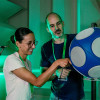
- The electronic sensor embedded in the brake pedal transmits precise and reliable information about the driver's braking demands to the car's control systems.
- This innovative system is already in production in certain VOLVO cars.
- This project will enable the two Basque companies to make a qualitative leap forward in the automotive sector and strengthen their position in the international automotive market.
The safest cars on the market are about to incorporate Basque technology made in BATZ and IKERLAN in one of the most critical systems in a vehicle: the braking system. The Biscayan cooperative and the IKERLAN technology centre have jointly developed an auxiliary sensor for the brake pedal for VOLVO, which will provide robustness and reliability.
This technology transfer project carried out for one of the world leaders in the automotive sector will enable the two Basque companies to make a qualitative leap forward in the automotive sector and strengthen their position in the international automotive market as a supplier of reliable electronic systems.
This is an important milestone for BATZ and IKERLAN. The two companies have been working together for four years on the development of this additional pedal component, which is equipped with sensors that precisely and reliably transmit information about the driver's braking demand. BATZ and IKERLAN have surpassed strict quality and safety standards in its design, as the Swedish manufacturer has set specific requirements for the project that are extremely demanding on several levels - robustness, integration and consumption - in addition to the regulations in force in the sector.
Iosu Gabilondo, head of Distributed and Connected Intelligence at IKERLAN, explains that "we had to guarantee the durability of the system, which must be able to operate for the 15 to 20 years of a vehicle's life cycle". Another challenge was "to integrate the new development with the rest of the electronic and mechanical systems in VOLVO vehicles, to adapt a magnetic system and to ensure its robustness and immunity. In addition, the Swedish company was extremely strict in defining the power consumption requirements of the system developed by BATZ and IKERLAN, another aspect of the company's high quality standards," explains Gabilondo.
The increasing digitalisation and automation of vehicles is leading to the gradual replacement of mechanical elements with electronic ones. Traditionally, vehicle pedals have responded to mechanical logic. They have evolved in terms of materials and safety requirements and now face the challenge of connectivity with the rest of the car's systems. From BATZ, Egoitz Anzola, Engineering Director of the Bizkaia-based cooperative, explains that "this new step will facilitate and help us to offer our customers not only integrated solutions in current brake pedals, but also in the design and manufacture of future electronic brakes. In this way, BATZ is responding to the natural evolution of brake by wire driving, with requirements for maximum functional safety in terms of sensors and the final braking system.
BATZ and IKERLAN agree that the integration of sensors in the braking system of VOLVO vehicles is an important milestone towards the development of a fully electronic brake pedal, which in turn is a major step towards the digitalisation of one of the most critical systems in a car.
The centre's income from technology transfer projects increased by more than 15 % and represented 54,2 % of the total turnover, with transport and mobility being one of the main sectors of activity, specifically 39 % of the transfer projects carried out by IKERLAN last year.
About IKERLAN
IKERLAN is a leading centre in technology transfer and in providing competitive value to industry. It offers integral solutions combining different technological domains in three main areas: digital technologies and artificial intelligence, embedded electronic systems and cybersecurity, and mechatronic and energy technologies. It currently has a team of 420 people and offices in Arrasate-Mondragón, Donostialdea and Bilbao. As a cooperative member of the MONDRAGON Corporation and the Basque Research and Technology Alliance (BRTA), IKERLAN represents a sustainable, competitive business model in permanent transformation. In 2024 IKERLAN will be 50 years old and remains faithful to its founding objective: to develop technology to improve the innovation and competitiveness of the companies in its environment.
About BATZ
BATZ is a worldwide supplier of products and services for the automotive sector. Founded in 1963, and based in Igorre (Bizkaia), it is part of MONDRAGON, one of the largest cooperative groups in the world. BATZ's commitment and customer focus have been fundamental in turning it into the solid industrial group it is today: more than 1300 people and a group turnover of 240 million. The company has distinguished itself by its strong commitment to innovation as a tool to meet the challenges of sustainability. And it is this approach, focused on people and the search for innovative solutions, which has enabled BATZ to consolidate its position as a benchmark in its sector.

Increasing a customised capital equipment factory’s production capacity by 20% or achieving 90% on-time deliveries (improving on the former rate of 40%), with the corresponding savings as less penalties need to be paid for delay, are all made possible by improvements in operational efficiency.
IK4-IKERLAN has started up production synchronisation projects with various client capital equipment manufacturing companies, helping them achieve these improvements.
The companies that manufacture capital equipment – equipment used to produce other goods, such as factory machinery – often have to face the problem of needing to produce customised goods to cater to their customers’ requirements. This means the production process is not standardised and project planning is more complex than for non-customised work, which can lead to delays, unnecessary expenses and low productivity.
To respond to this need, IK4-IKERLAN has set up production sychronisation projects with different client companies in this sector. It has succeeded in creating a quick, efficient production schedule, coordinating the company’s different departments and its suppliers.
This has not only led to cost savings (as less time is spent on production and less penalties are incurred for customer delivery delays) but has also enabled the companies to boost their income due to increased productivity.
IK4-IKERLAN’s role in these projects is to formalise production processes, define scheduling patterns and order the company’s workflow, with a view to achieving reliable delivery dates.
The fact that different departments are all involved in a typical contract for a capital equipment production company - technical/sales, design, purchasing and assembly - means a good workflow between them is vital for the company’s efficiency, as a delay in any of the production steps affects the whole process up to delivery, resulting in lost competitiveness.
"We want to convince our clients that each of the company departments should treat the next one in the process as a client", explains Juan Manuel Besga, an IK4-IKERLAN researcher.
The results of IK4-IKERLAN’s work on projects of this type have been aired at the MCPC (World Conference on Mass Customization, Personalization and Co-Creation), a benchmark congress in the mass customisation area recently held in Aalborg (Denmark).
