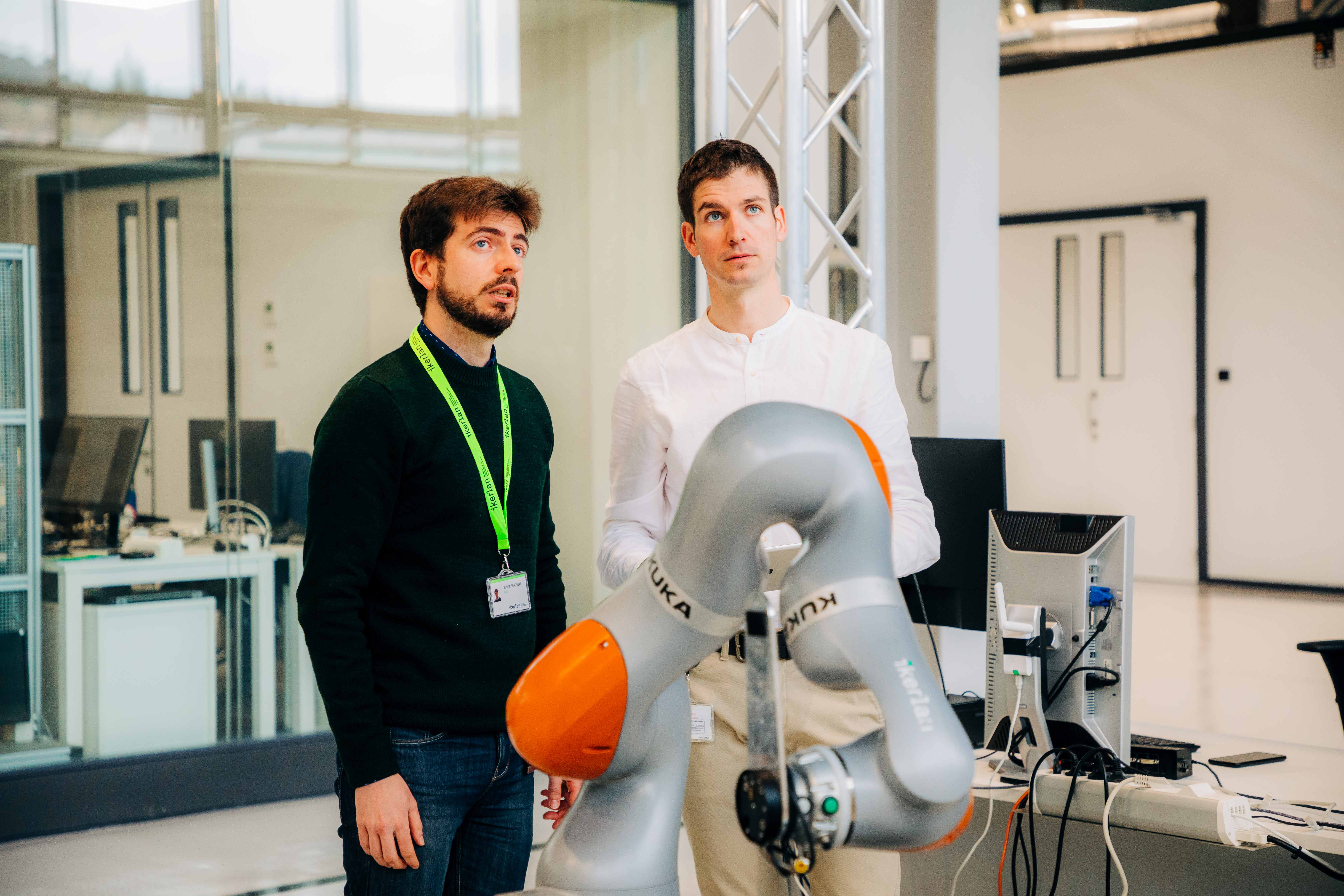
• This project represents a leap in the automation of industry by allowing cooperation between multiple robotic platforms thanks to communication systems and distributed decision algorithms that guarantee robustness, flexibility and operational continuity even in the event of failures or unforeseen events..
• IKERLAN's alliance with the Navarre-based company strengthens Aldakin's strategy to position itself as a direct supplier of large manufacturers such as Mercedes-Benz, by providing high-value technological solutions that are more efficient than those of its competitors.
The IKERLAN technology centre has been collaborating for years with the Navarrese company Aldakin, a leader in precision robotics, in the development and improvement of the capabilities of the commercial robotic systems that it integrates in its industrial automation solutions. This has enabled the company to establish a leading position in the collaborative and mobile robotics sector. It has also facilitated collaboration on relevant projects with prominent national and international partners, including the Mercedes-Benz Vitoria Factory and the German Research Center for Artificial Intelligence (DFKI).
Both entities are currently involved in the SIAM project, which will represent a qualitative leap in this sector by enabling cooperation between multiple robotic platforms that can work in a coordinated manner for complex tasks such as the swarm transport of heavy or large loads. The development of new communication mechanisms and distributed decision algorithms will guarantee the resilience of the solution, improving its robustness, flexibility and operational continuity even in the event of failures or unforeseen events.
They previously collaborated on the CoMAr project for Mercedes-Benz, the genesis of this endeavour. The project entailed the development of a collaborative mobile robotic manipulator capable of operating in close proximity to human operators. The system's advanced control capabilities enable dynamic adaptation to human movements, enhancing both safety and work efficiency. This line of innovation was extended with the HERON project, which incorporated advanced autonomous navigation capabilities based on artificial intelligence. These allow robots to move safely in highly dynamic industrial environments, making decisions in real time in the presence of people or obstacles thanks to a proprietary navigation system.
Thanks to innovations introduced by the technology centre in the commercial control system - the ‘brain’ of the robots - these machines go beyond their standard functions and acquire advanced capabilities for autonomous decision-making and dynamic, real-time adaptation to unknown or unforeseen situations, which conventional systems do not allow by default. This allows them, for example, to collaborate more safely and efficiently with operators, to move efficiently around the factory without collisions with people or obstacles, and even to cooperate with each other to execute joint tasks
‘The CoMAr, HERON and SIAM projects that we have developed together represent a coherent and progressive evolution in the field of intelligent mobile robotics applied to industrial environments and respond to the challenges of the industry of the future. In this case, we have managed to turn the concept of collaborative robotics on its head so that it is the robot that autonomously adapts to people’, says Gorka Sorrosal, researcher in intelligent control and robotics at IKERLAN and head of the projects developed with Aldakin.
In collaboration with IKERLAN, the Navarrese company has successfully developed its own solutions in control, trajectory planning and intelligent navigation. These solutions include advanced coordination and communication mechanisms between mobile robots. These mechanisms enable the formation of robotic swarms capable of operating cooperatively in highly dynamic environments. All of this has been developed while ensuring the safety of people at all times, as the robots are designed to detect them and dynamically adapt their behaviour, preventing them from invading their safe space. At the same time, it is vital to ensure that the equipment's operational capacity is maintained and that significant efficiency losses are avoided. . This is possible thanks to the monitoring systems, active compensation, real-time reactive control and synchronisation between robots and operating personnel that IKERLAN has incorporated into the commercial platforms.
This collaboration is another example of a successful technology transfer project from the centre to industry, a fundamental value of IKERLAN since its beginnings and a business segment that is consolidated year after year as the centre's economic driving force.